
The Fourth Trimester, Honestly: A Nelson Doula's Guide to Your First Weeks with a Newborn
You have 10 months to prepare for your birth. You’ve read the books (some good, some not), gone to the appointments, done the yoga, and listened to all of the podcasts.
You prepare for birth, you give birth…
THEN someone hands you a tiny human …now what?
What is the fourth trimester?
The “fourth trimester” refers to the (roughly) 12 weeks after your baby is born. The idea is that your newborn isn't really "done" cooking at birth - human babies arrive needing a lot of the same things they had on the inside: warmth, closeness, near-constant feeding, and gentle, contained comfort. They're adjusting to the great wide world, and you're adjusting to a brand-new identity as someone's parent (there's even a word for that shift ✨ matrescence✨ and it's as real as the physical recovery).
So the fourth trimester is two transitions happening at once: your baby learning to be earthside, and you becoming a parent. It feels like a LOT, because - it is! And that’s totally normal.
First, the honest part
Here's what I tell every family I work with: it is so, so normal for these weeks to feel hard. The beautiful blow-outs, dewy-makeup hospital pics are not real life - and that’s beautiful. The Fourth Trimester is raw, and undone, that’s where the beauty is.
Survival mode is a season, not a personal failing. In the early days, the bar is just this:
Your baby is fed, held, loved + safe
… and so are you
Everything else can wait. It might be uncomfortable, but it’s a season and this one can be messy.
I’ve never heard someone describe the 4th Trimester as “easy” - BUT there are a lot of things you can do before baby arrives to help make things a bit easier.
Getting to know your newborn
Newborns can't talk, but they communicate constantly - and learning to read their signals, takes the guesswork out of a lot of those early moments. You'll start to spot early hunger cues (rooting, turning when their cheek is touched, hands to the mouth) before the crying even starts, and notice the difference between "tired" and "overstimulated."
And then there's the witching hour: that late-afternoon-into-evening stretch where a perfectly content baby decides to fuss, seemingly about nothing. It's incredibly common, and having a go-to soothing toolkit makes it survivable - think swaddling, gentle motion, skin-to-skin, sound, and sucking. Tag-teaming with a partner or support person helps too, so one person isn't white-knuckling the evenings alone.
One thing worth knowing now: if you ever feel overwhelmed, it is always safe to put your baby down somewhere safe, like their crib, bassinet, and step away for a few minutes to breathe. Or take the intensity down a couple notches by using some noise cancelling headphones, or sound dampening earbuds (these SAVED me with my first baby!). A crying baby in a safe spot is okay; a shaken baby is never okay. And trust your gut on the not-normal stuff - a fever in a baby under three months, for example, is always a call-your-medical provider moment.
Feeding in the real world
Whether you're breast/chest feeding, bottle feeding, formula feeding, or some combination of all-of-the-above - feeding a newborn is a learned skill for both of you, and it can be genuinely hard at first.
Cluster feeding (when it feels like baby wants to eat every twenty minutes for hours) = normal
Feeding on cue rather than by the clock = normal
The apps can be really helpful for remembering, or looking at trends - but obsessively tracking feeds, diapers, and naps can cause more anxiety and frustration (for everyone) in the end.
The single most useful thing I can tell you: if feeding hurts, feels off, or you're worried baby isn't getting enough, get help early. You don't have to white-knuckle it. A single visit (or call) with a lactation consultant (IBCLC) can save you days of Googling (and lot of tears).
Sleep, realistically (and safely)
Let's set expectations: newborns sleep a lot, but in short, scattered chunks, and day/night confusion is completely normal at first (newborn babies don’t have their own circadian rhythm). Frequent waking isn't a problem to fix - it's how tiny humans are built and it’s expected.
On the safety side, this is one area where it's worth following clear, current guidance. In Canada, the recommendation from the Canadian Paediatric Society and Health Canada is the "ABCs":
your baby sleeps Alone (no soft bedding, pillows, bumpers, or loose blankets)
on their Back
in a Crib, bassinet, or cradle that meets current Canadian safety standards - ideally in your room, on their own surface, for the first six months. Resources like Baby's Best Chance and Perinatal Services BC Hub walk through all of it. And, if bed-sharing is something you're considering: talk it through with your provider and learn how to reduce the risks - the most important being to never fall asleep with baby on a couch or armchair. I strongly recommend to all of my clients, that even if they don’t plan to bed-share, they should learn how to do it as safely as possible. Most parents that do end up bed-sharing didn’t plan to do so.
Wear your baby
Babywearing is one of my FAVOURITE fourth-trimester tools, and not just because it's so nice 🥰 A good carrier soothes a fussy baby, keeps them close in that womb-like way they crave, and gives you your hands back so you can eat lunch, walk the dog, or wrangle a toddler.
The key is wearing safely: baby high and snug, close enough to kiss, with their chin off their chest and airway always clear. You can check out my safe babywearing checklist tool here 👉 T.I.C.K.S Checklist. There are lots of carrier styles: stretchy wraps, ring slings, soft-structured carriers. The "best" one is simply the one that fits your body and your baby. (If you want hands-on help finding it, that's exactly what my one-on-one babywearing consults are for! 👉 Contact me to set-up a Consult)
My two FAVOURITE carriers for the 4th Trimester are the:
The Beluga Baby Wrap by Beluga Baby 🇨🇦
Don't forget about you
Here's the part that gets skipped in most newborn prep: you are recovering too, and you matter just as much as your baby.
Physically, give yourself grace and know your warning signs, like heavy bleeding, fever, severe pain, or anything that feels alarming is worth a call to your provider, and that's true for weeks after birth, not just the first few days. Cesarean recovery in particular takes longer than people expect.
Emotionally, the fourth trimester is a big one. The "baby blues" - weepy, up-and-down feelings in the first couple of weeks - are very common and usually pass. But postpartum mood and anxiety disorders are also common (roughly 1 in 5 birthing parents, and partners can experience them too, this risk increases if you have a previous history of depression or anxiety), and they're nothing to be ashamed of. If the heavy feelings linger, intensify, or include scary intrusive thoughts, please reach out to your provider, or to a support line like the BC Mental Health Support Line (1-800-784-2433). Getting help early is a sign of strength, and it works.
Build your village
You were never meant to do this alone. Some of the most useful "newborn prep" has nothing to do with the baby: lining up meals, setting gentle visitor boundaries ("we'd love help with a load of laundry” and “please text before you come"), and getting clear with your partner on who's doing what. Here in Nelson and the West Kootenays, there's also real community support, public health nurses, postpartum doulas, lactation help, and parent groups - once you know where to look 🤍
The fourth trimester is learnable
If there's one thing to take from all of this, it's that the newborn weeks aren't a mysterious ordeal you just have to survive, they're a season you can genuinely prepare for. A little knowledge turns "I have no idea what I'm doing" into "okay, I've got this."
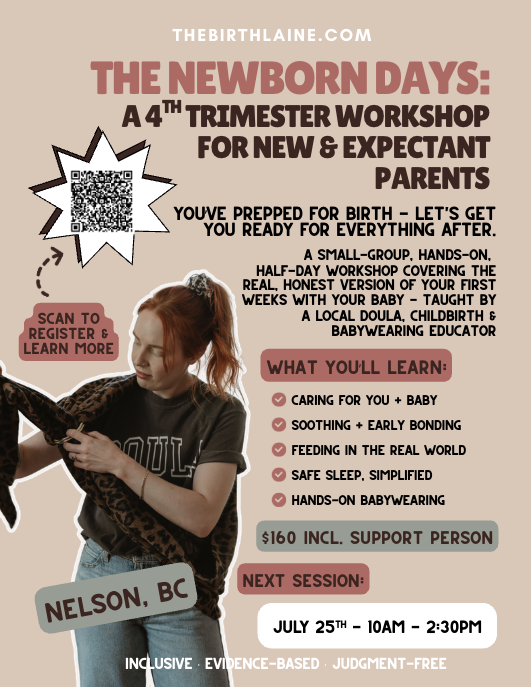
That’s why I created The Newborn Days a hands-on, half-day workshop for first-time parents (or seasoned parents that just want a refresher!) that covers everything above in real, practical detail: soothing, feeding, safe sleep, daily care, babywearing (with real carriers to try), and caring for you. It's a small group, it's judgment-free, and you'll walk out feeling calmer and more capable about those first weeks at home.
It runs in person in Nelson, BC, and I also offer it one-on-one and virtually for families across Canada and the US. Join us and learn more about upcoming workshop dates! 👉 The Newborn Days: Postpartum & Newborn Care Workshop
You've got this. And if you'd like a hand getting ready, that's what I'm here for. 🤍
A few quick fourth-trimester FAQs
-
It begins the moment your baby is born and runs through roughly their first twelve weeks - though the adjustment, for both of you, can stretch a bit beyond that.
-
Completely. The early weeks are intense, and finding them hard doesn't mean anything is wrong with you or your baby. If heavy feelings linger or worsen, reach out to your provider or a postpartum support line - support helps.
-
The third trimester is the perfect time to learn the practical skills (feeding, soothing, safe sleep, babywearing), set up your support plan, and get familiar with local resources - which is exactly what a newborn-care workshop like The Newborn Days is designed to do.
Laine Ferguson is a certified full-spectrum doula, childbirth educator, and babywearing educator based in Nelson, BC, serving families across the West Kootenays — and virtually across Canada and the US.
A gentle note: I'm a birth doula, childbirth educator, and babywearing educator, not a physician, midwife, or other medical provider. This post is for general education and support only, and it isn't medical advice or a substitute for care from your own qualified healthcare provider. Every pregnancy, baby, and recovery is different, so please bring any questions or concerns to your healthcare team, and if you ever think you or your baby need medical attention, contact your provider or local emergency services right away. 🤍
🔗 Affiliate Disclosure
Some of the links in this post are affiliate links through Amazon.ca. As an Amazon Associate, I may earn a small commission from qualifying purchases, at no additional cost to you. I only share products I have personally used, or would recommend to my Clients. Any commissions earned support growing my business to support more families on their pregnancy, birth and parenting journeys.
